
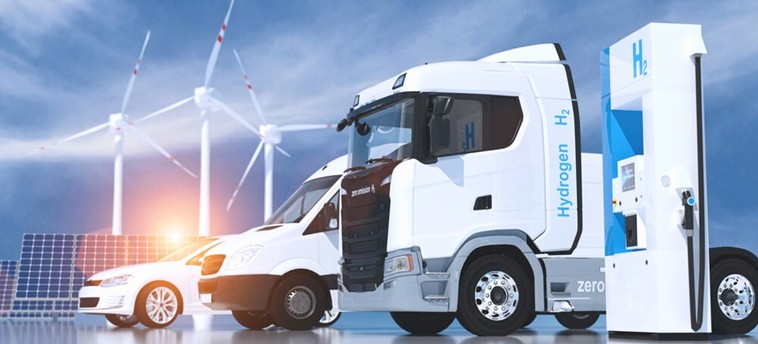
Hydrogen Mobility: A Technology Still Searching for Scale
What is Hydrogen Mobility?
- Hydrogen Mobility refers to using hydrogen as a fuel source for transportation, primarily in Fuel Cell Electric Vehicles (FCEVs).
- FCEVs are a type of electric vehicle that uses a fuel cell stack to generate electricity onboard. This electricity is created by converting compressed hydrogen gas (stored in a tank) and oxygen (from the air) into power.
FCEV Architecture and Working Mechanism:
Core Principle: FCEVs generate electricity onboard using a fuel cell stack, where hydrogen reacts with oxygen to produce electricity, water vapor, and heat.
Energy Flow: Hydrogen stored in high-pressure tanks feeds the fuel cell. Electricity powers an electric traction motor.
Battery Role: A small battery stores energy from regenerative braking and provides extra power during acceleration.
FCEVs offer unique advantages and differences when compared to both traditional internal combustion engines (ICE) vehicles and Battery Electric Vehicles (BEVs).
| Feature | Internal Combustion Engine (ICE) | Battery Electric Vehicle (BEV) | Fuel Cell Electric Vehicle (FCEV) |
| Power Source | Gasoline or Diesel | Stored Electricity (Battery) | Hydrogen Gas (Converted to Electricity) |
| Tailpipe Emissions | Harmful pollutants (CO2, NOx, Particulates) | Zero | Zero (Water Vapor & Warm Air) |
| Refueling/ Recharge Time | Quick (3-5 Minutes) | Slow to Fast (30 mins – Several hours) | Quick (3-5 Minutes) |
| Driving Range | Long | Varies (Can cause “range anxiety”) | Long (Comparable to ICE) |
| Energy Efficiency | Low (approx. 20-40%) | High (approx. 80-90% from grid to wheel) | Moderate (approx. 40-60% from hydrogen to wheel) |
Key Differences between FCEV, ICE and BEV
Efficiency losses across energy pathways significantly impact on the overall performance, cost, and environmental footprint of vehicle technologies. Each conversion step—from energy generation to delivery at the wheels—introduces inefficiencies that influence how practical and sustainable these solutions are.
Thermal Resilience: Why FCEVs Excel in Cold Climates:
Cold climates significantly impact energy efficiency and range for zero-emission vehicles. BEVs experience severe range degradation due to:
- Battery chemistry limitations at low temperatures.
- Increased HVAC loads for cabin heating.
- Slower charging rates in cold conditions.
FCEVs, however, maintain higher efficiency because:
- Fuel cells generate heat during operation, reducing HVAC energy draw.
- Hydrogen reaction kinetics are less sensitive to ambient temperature.
- Refueling time remains constant regardless of temperature.
Global investment in FCEV Scalability:
The Hydrogen Council’s September 2025 update reports $110 billion in committed investments, covering projects that have reached final investment decisions. Making it the most current and reliable indicator of capital deployment in the sector. Here are the countries committed to supporting the Hydrogen Ecosystem.
Major players and FCEVs scalability:
Large global automotive and industrial players are driving scale and commercial viability by focusing FCEV deployment on high-demand segments like heavy-duty transport, where hydrogen’s range and quick refueling offer a distinct advantage over batteries.
Major OEMs like Toyota and Hyundai are not only competing with passenger vehicles but are also investing heavily in forming global partnerships to build the entire hydrogen ecosystem, from fuel cell manufacturing to logistics, production, and refueling infrastructure.
Global Momentum:
Global momentum for fuel cell electric vehicles (FCEVs) has slowed compared to earlier expectations, primarily due to infrastructure challenges, high hydrogen production costs, and strong competition from battery electric vehicles. However, FCEVs continue to gain attention in specific niches such as heavy-duty transport and commercial fleets, where their advantages in long range and fast refueling remain compelling.
Closing Insights:
- Passenger FCEVs are a shrinking niche for now: Global sales fell ~27% YoY in H1‑2025; California’s retail H2 network is ~50 stations and reliability issues persist—BEVs win on cost, convenience, and model breadth.
- Heavy‑duty is the realistic FCEV beachhead: Duty‑cycle logic (range, fast refuel, payload) is a key. However, most ZE truck growth is BEV today; FC trucks are <1% of heavy truck sales in China. FCEV wins where duty cycles demand long range, high uptime, and centralized fueling.
- Capital is flowing & demand is the next stage: The Hydrogen Council shows $110B committed across 500+ mature projects, ~6 mtpa (million tonnes per annum) supply capacity, but only ~3.6 mtpa binding offtake. FCEV success hinges on locking in offtake (fleets, corridors, municipal buses) and hydrogen at competitive delivery cost.
- Pragmatic outlook: FCEVs will complement BEVs: Expect passenger cars to stay BEV‑led to 2030, while FCEVs scale selectively where depot fueling and uptime matter most.