China’s EV Revolution: Leading Towards a Sustainable Future
China’s Electric Vehicle Revolution: Leading the Charge Towards a Sustainable Future
The global automotive industry is undergoing a monumental shift, and at the forefront of this transformation is China’s electric vehicle (EV) sector. What was once a nascent industry is now a formidable force, rapidly accelerating towards global dominance and redefining the future of transportation. China isn’t just participating in the EV revolution; it’s leading it, setting an aggressive pace that the rest of the world is scrambling to match.
A Decade of Dominance: The Numbers Speak for Themselves
China’s journey to EV leadership is a testament to strategic foresight, robust government support, and an insatiable domestic market. The statistics are staggering:
-
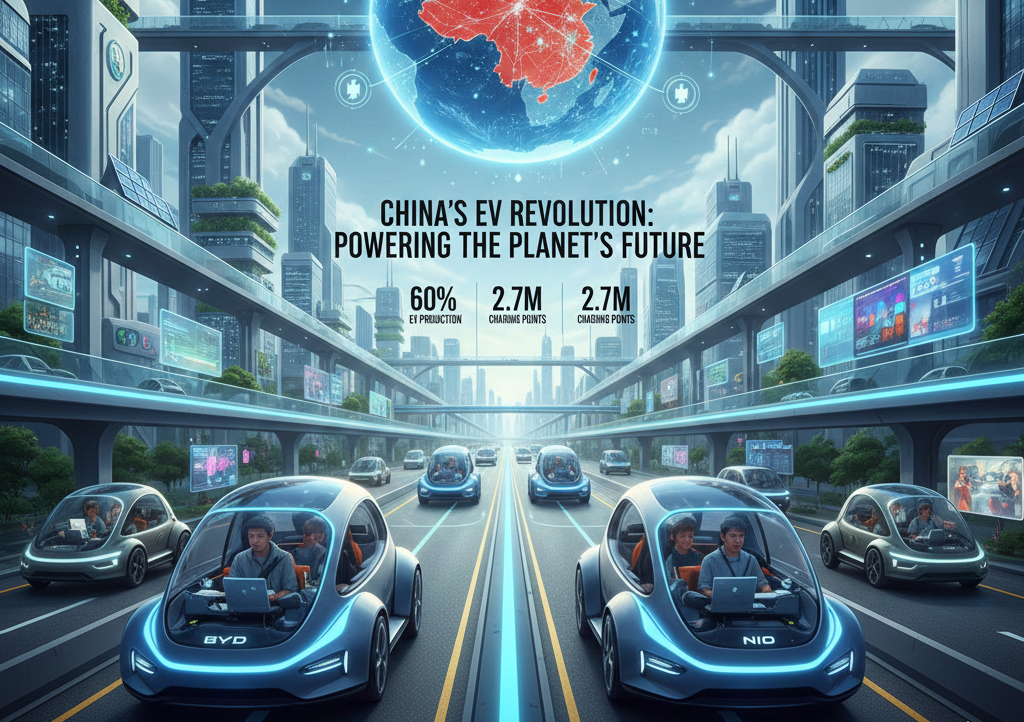
Production Powerhouse: In 2023, China produced an estimated 9.5 million new energy vehicles (NEVs), which include battery electric vehicles (BEVs) and plug-in hybrid electric vehicles (PHEVs), accounting for over 60% of global EV production. This massive scale allows for economies of scale and rapid innovation.
-
Market Share Surge: China’s domestic EV sales are equally impressive, with NEVs making up over 35% of all new car sales in the country. This contrasts sharply with many Western markets, where EV penetration is still catching up.
-
Export Explosion: Chinese EV manufacturers are no longer content with domestic success. In 2023, China exported over 1.2 million NEVs, a significant leap from previous years. Brands like BYD, SAIC, and Nio are making substantial inroads into European, Southeast Asian, and South American markets, challenging established automotive giants.
-
Infrastructure Investment: To support this growth, China has also built the world’s most extensive EV charging network, with over 2.7 million public charging points by the end of 2023. This comprehensive infrastructure addresses one of the primary concerns for potential EV buyers globally.
The Pillars of Chinese EV Supremacy
Several factors underpin China’s commanding lead:
-
Government Vision and Support: The Chinese government identified EVs as a strategic industry early on, offering generous subsidies, tax breaks, and preferential policies for manufacturers and consumers. This sustained support created a fertile ground for innovation and competition.
-
Vertical Integration and Supply Chain Mastery: China has invested heavily in the entire EV supply chain, from raw material extraction and battery production (dominated by giants like CATL and BYD) to vehicle assembly. This vertical integration reduces reliance on external suppliers and provides a competitive cost advantage.
-
Rapid Innovation and Technological Advancement: Chinese EV companies are not just replicating; they are innovating at an incredible pace. They are leading in battery technology, smart cockpit features, autonomous driving solutions, and new business models like battery-swapping services.
-
Fierce Domestic Competition: The sheer number of EV manufacturers in China, ranging from established players to agile startups, has fostered an intensely competitive environment. This forces companies to constantly innovate, improve quality, and offer competitive pricing, ultimately benefiting consumers.
-
Consumer Acceptance and Digital Integration: Chinese consumers have embraced EVs with enthusiasm, partly due to government incentives and also because Chinese EVs often come packed with advanced digital features, seamless connectivity, and appealing designs that resonate with a tech-savvy generation.
A Glimpse into the Future: China’s Role in a World of Electric Mobility
Imagine a world where the hum of internal combustion engines is a distant memory, replaced by the silent, efficient glide of electric vehicles. In this future, China’s influence will be indelible.
We envision urban landscapes transformed by smart, interconnected EV fleets. Autonomous electric taxis and buses, many originating from Chinese manufacturers, will navigate bustling city centers, reducing traffic congestion and pollution. Personal mobility will be redefined by sleek, customizable EVs that double as mobile offices or entertainment hubs, powered by advanced battery technologies developed in Chinese research labs.
China will likely be a primary source of these vehicles, not just for its own vast market but for a significant portion of the global demand. Its manufacturers will continue to push the boundaries of battery range, charging speed, and vehicle-to-grid (V2G) technology, allowing EVs to become integral components of smart energy grids.
The competition will undoubtedly intensify, with traditional automakers making significant strides. However, China’s early lead, economies of scale, and relentless pursuit of innovation have positioned it as a long-term leader in the global EV landscape. The country’s strategic vision for a sustainable future, powered by electric mobility, is not just a national ambition but a blueprint for the world. As the planet grapples with climate change and the need for greener transportation, China’s electric vehicle revolution offers a compelling and powerful path forward.