eVTOLs and the Future of Urban Mobility
The Dawn of a New Era: eVTOLs and the Future of Urban Mobility
For decades, the idea of flying cars has captivated the human imagination, a staple of science fiction promising a future free from traffic congestion. Today, that future is closer than ever, not with traditional “flying cars,” but with electric Vertical Take-Off and Landing (eVTOL) aircraft. These innovative vehicles are rapidly evolving from ambitious concepts into a tangible reality, poised to revolutionize urban mobility and transportation as we know it.
A Quiet Revolution Takes Flight
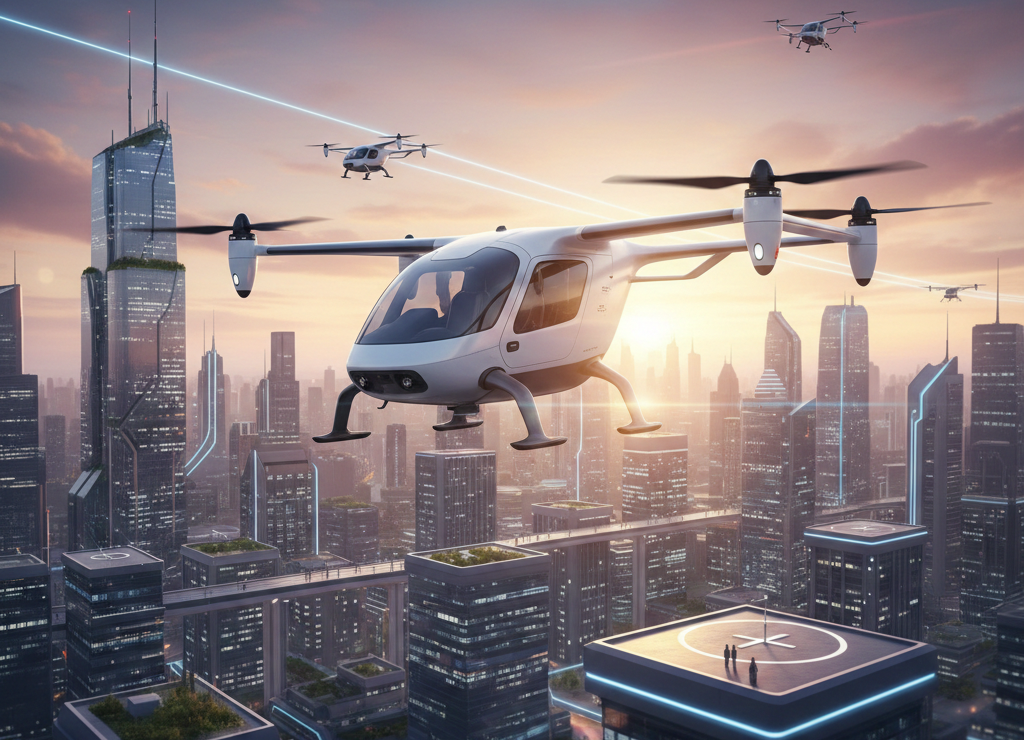
eVTOLs are essentially electric helicopters or multi-rotor aircraft designed for short-to-medium distance travel, primarily within urban and suburban environments. What sets them apart is their electric propulsion systems, which offer several key advantages over traditional aircraft:
-
Zero Emissions: Operating on electricity means eVTOLs produce no direct emissions, contributing to cleaner air in cities.
-
Reduced Noise Pollution: Electric motors are significantly quieter than jet engines or gasoline-powered rotors, making them more palatable for urban operations.
-
Vertical Take-Off and Landing: This eliminates the need for long runways, allowing eVTOLs to operate from vertiports on rooftops or existing helipads.
-
Enhanced Safety: With multiple rotors and advanced flight control systems, eVTOLs are designed with redundancy and automation in mind.
Rapid Evolution and Investment
The eVTOL industry is currently experiencing a period of explosive growth and innovation. Major aerospace companies, automotive giants, and nimble startups are pouring billions into research, development, and certification.
-
Investment Surge: According to Morgan Stanley, the eVTOL market could reach $1 trillion by 2040 and potentially $9 trillion by 2050, signifying immense investor confidence.
-
Prototyping and Testing: Numerous prototypes are undergoing rigorous testing globally, with companies like Joby Aviation, Archer Aviation, Lilium, and Volocopter leading the charge. Many have already completed thousands of successful test flights.
-
Strategic Partnerships: Collaborations between eVTOL manufacturers and ride-sharing companies (e.g., Uber Elevate, now a partnership with Joby) and airlines are paving the way for integrated urban air mobility networks.
The Global Impact and Importance
The rise of eVTOLs has far-reaching implications that extend beyond just commuting.
-
Solving Urban Congestion: As global urbanization continues, traffic congestion is a growing problem, costing economies billions and impacting quality of life. eVTOLs offer a third dimension to transportation, potentially alleviating surface-level gridlock.
-
Increased Accessibility: eVTOLs could connect remote areas with urban centers more efficiently, opening up new possibilities for regional travel and emergency services.
-
Logistics and Cargo: Beyond passenger transport, eVTOLs are being explored for rapid package delivery and urgent cargo transport, especially in congested urban areas or challenging terrains.
-
Economic Growth and Job Creation: The burgeoning eVTOL industry will create thousands of jobs in manufacturing, engineering, operations, maintenance, and infrastructure development.
-
Sustainability Goals: As nations strive to meet ambitious climate goals, the adoption of zero-emission eVTOLs can play a significant role in decarbonizing the transportation sector.
Challenges on the Horizon
While the promise is immense, the eVTOL industry faces significant hurdles:
-
Regulation and Certification: Airworthiness certification from aviation authorities like the FAA (USA) and EASA (Europe) is a complex and lengthy process. Establishing clear air traffic management protocols for urban airspaces is also critical.
-
Infrastructure Development: A network of “vertiports” – dedicated take-off/landing sites – will need to be developed within cities, along with charging infrastructure.
-
Public Acceptance: Gaining public trust and acceptance regarding safety, noise levels, and affordability will be crucial for widespread adoption.
-
Battery Technology: While rapidly improving, battery energy density and charging times remain areas of ongoing development to maximize range and operational efficiency.
-
Cost: Initial costs of eVTOL operations will likely be high, targeting premium services first, before economies of scale bring prices down for wider accessibility.
The Road Ahead
The next few years will be pivotal for the eVTOL industry. We are likely to see the first commercial passenger operations begin in select cities globally by the mid-2020s, starting with piloted operations and gradually moving towards greater autonomy as technology and regulations evolve.
The future of urban mobility is undeniably looking up. With relentless innovation, strategic investments, and collaborative efforts between industry and regulators, eVTOLs are poised to transform our cities, making them quieter, cleaner, and more connected than ever before. The dream of personal air travel is no longer a distant fantasy; it’s on the verge of becoming a part of our everyday reality.