Germany’s Automobile Industry at a Crossroads
The End of an Era? Germany’s Automobile Industry at a Crossroads
For decades, the phrase “German engineering” was synonymous with automotive excellence. From the luxury of Mercedes-Benz and BMW to the precision of Audi and the reliability of Volkswagen, German cars set global benchmarks for quality, performance, and innovation. They were symbols of national pride and economic prowess. Yet, a palpable shift is underway, threatening to dismantle this long-held dominance. Germany’s once unassailable position in the global automobile industry is faltering, challenged by new technologies, fierce competition, and a changing world order.
Cracks in the Foundation: The Numbers Tell a Sobering Story
The decline isn’t a sudden collapse but a gradual erosion, accelerated by recent global shifts. The statistics paint a concerning picture:
-
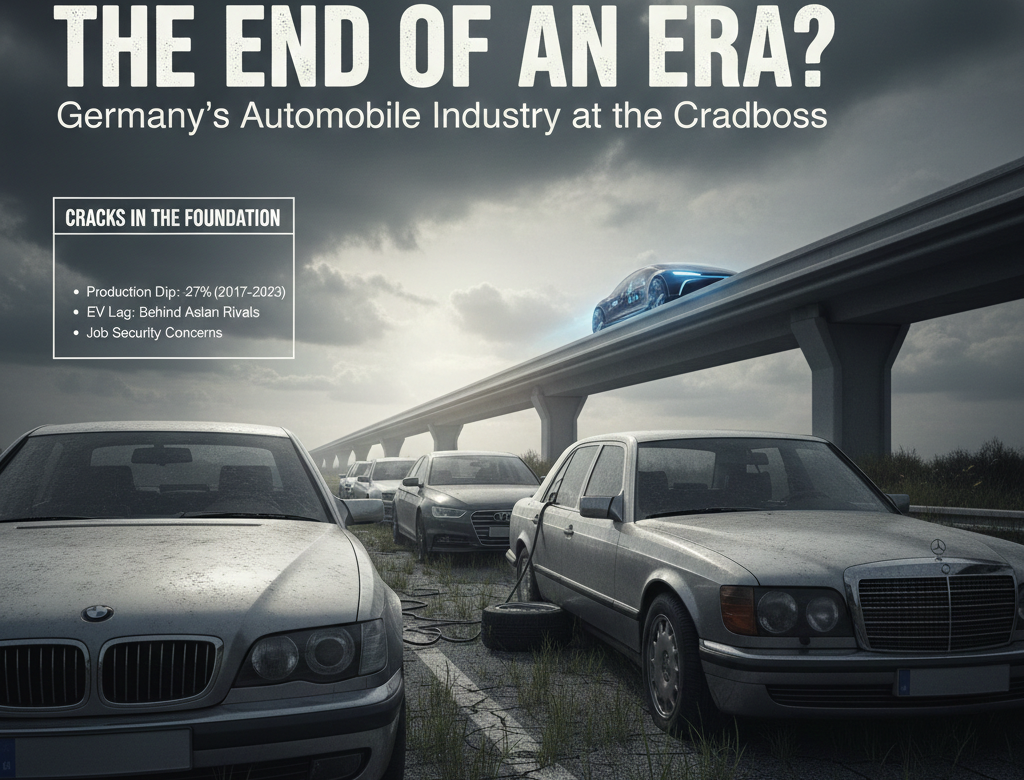
Production Dip: While still significant, German car production has been on a downward trend. In 2017, Germany produced over 5.6 million passenger cars. By 2023, this figure had fallen to approximately 4.1 million units, a substantial drop reflecting both internal challenges and external market pressures.
-
Market Share Erosion: German brands are losing ground globally, particularly in the crucial electric vehicle (EV) segment. While exact global market share figures for German EVs are harder to isolate due to varied reporting, their pace of EV adoption and production lags significantly behind competitors, especially from Asia.
-
The EV Lag: Germany was slow to embrace the electric revolution. In 2023, while EVs constituted over 35% of new car sales in China, and a growing percentage in other markets, German manufacturers faced an uphill battle to transition their traditional combustion engine strongholds. This delay has allowed competitors to establish dominant positions in battery technology and charging infrastructure.
-
Dependence on China: Paradoxically, as China’s EV industry thrives, German automakers have grown increasingly reliant on the Chinese market for sales of their premium combustion engine vehicles. This dependence creates vulnerability as China pushes its domestic brands and transitions rapidly to EVs.
-
Job Security Concerns: The shift from combustion engines to EVs requires fewer parts and different manufacturing processes, leading to anxieties about job security within Germany’s highly skilled automotive workforce. Estimates suggest tens of thousands of jobs could be at risk in the coming years due to this transition.
Why the Mighty Are Stumbling: Factors Behind the Decline
Several interconnected issues contribute to Germany’s automotive woes:
-
The Dieselgate Scandal: The emissions scandal that rocked Volkswagen in 2015 severely damaged the reputation of German engineering and led to massive fines, diverting resources and trust away from innovation.
-
Sluggish EV Transition: Germany’s traditional focus on internal combustion engines (ICE) meant a delayed and sometimes hesitant pivot to electric vehicles. This conservatism allowed newcomers and proactive nations to gain a significant head start in battery technology, software integration, and mass EV production.
-
Software and Digitalization Deficiencies: While mechanically superb, German automakers have struggled to compete with tech giants and agile EV startups in terms of in-car software, connectivity, and user experience. The “digital car” is becoming as important as the mechanical one, and here Germany often lags.
-
Supply Chain Vulnerabilities: The COVID-19 pandemic and geopolitical tensions exposed vulnerabilities in the global automotive supply chain, particularly regarding semiconductors, impacting German production significantly.
-
Rising Costs and Bureaucracy: Germany’s high labor costs, stringent regulations, and sometimes slower decision-making processes can hinder the agility needed to compete in a rapidly evolving global market.
-
Intense Global Competition: The emergence of highly competitive and innovative EV manufacturers, particularly from China and the US (e.g., Tesla), has created an unprecedented level of competition that challenges Germany’s traditional market segments.
A Crossroads for the Titans
The road ahead for Germany’s automobile industry is fraught with challenges, yet also opportunities. The question isn’t whether German brands will disappear, but whether they can adapt quickly enough to regain their former glory. This requires a radical shift in mindset, a renewed focus on software and battery technology, and a willingness to embrace disruption rather than resist it.
The romantic era of German automotive supremacy, built on the roar of a perfectly engineered engine, may be fading. A new chapter is being written, and whether Germany will be a protagonist or a cautionary tale remains to be seen. The world watches as the titans of tradition grapple with the undeniable forces of change.